If you’re a school leader, you’ve likely heard the murmurs in the staffroom or felt the tension in meetings: a sense of “us versus them” when it comes to teacher wellbeing. Teachers might feel leadership doesn’t care about workload or morale, while leaders might feel unfairly blamed for every dip in happiness. It’s an easy trap – a blame game that pits staff against leadership. Yet this narrative helps no one. Instead of finger-pointing, imagine what we could achieve by seeing wellbeing as a shared responsibility. Research suggests that employers and employees both have roles in this relationship, where clear communication and mutual commitment are key (Hogan Assessments, 2022).
In other words, cultivating a healthy work environment isn’t solely the job of the school leader or the teacher – it’s a partnership.
Moving away from blame starts with a shift in mindset: focusing not just on short-term “happiness” perks, but on deeper workplace fulfilment for staff. This means looking beyond surface-level wellness gestures (like free coffee or Friday cookies) and building a culture where educators find purpose and satisfaction in what they do. And it turns out, that’s exactly what most people want. Recent studies show that employees are increasingly driven by meaning in their work. In fact, up to 9 out of 10 workers would trade some pay for a job that gives them a stronger sense of purpose (as one Harvard Business Review report found, “meaning is the new money”). Moreover, about 70% say their work is a major part of their personal sense of purpose (Sinek, 2009). These findings echo leadership expert Simon Sinek’s observation that people are inspired not just by what they do, but why they do it. Sinek famously notes that “working hard for something we don’t care about is called stress; working hard for something we love is called passion.” (Sinek, 2009, p. 106).
In a school context, this suggests that a teacher who is up late grading papers might feel stressed – but if those late nights connect to a meaningful purpose (like helping students thrive), the hard work can instead feel like part of a passionate mission.
So how do we tap into that passion? How can school leaders and staff together create an environment where hard work leads to fulfilment rather than burnout? It starts with defining what we really mean by workplace fulfilment, and understanding how it fits into the bigger picture of wellbeing.
What Is Workplace Fulfilment?
Let’s begin with a working definition.
“Fulfilment in work occurs when staff align with their school’s vision, apply meaningful effort and experience a sense of purpose as a result. It also requires school leaders create a supportive environment where expectations are clear and staff feel valued, recognised and are given opportunities to grow.”
This definition outlines the fact that there is a shared responsibility in developing workplace fulfilment. Staff need to buy into the school’s / trust’s vision and values, while the school / trust need to create a supportive organisations that values all staff.
Let’s explore the first part of the definition; “Fulfilment in work occurs when staff align with their school’s vision, apply meaningful effort, and experience a sense of purpose as a result.” In practice, this means teachers and support staff see how their daily tasks connect to a larger goal for the school and its students. They’re not just marking homework or supervising lunch; they’re contributing to a vision of student success and a better community. When that alignment between personal values and school vision happens, work stops feeling like “just a job” and becomes a mission. As leadership author Jim Collins put it, “Building a visionary [organization] requires one percent vision and 99 percent alignment.” In other words, having a great school vision is one thing, but it’s the collective alignment and buy-in of all staff that truly drives success (Collins, 2001, p. 211). School leaders need to clearly communicate the “vision” (the why behind the work) and invite staff to own it too – to make it their vision. When teachers believe in the purpose of their school, they willingly put in the extra effort – or as Sinek says, they’ll work “with blood, sweat, and tears” for a cause they believe in (Sinek, 2009).
Of course, purpose alone isn’t enough. The definition also highlights that; “School leaders create a supportive environment where expectations are clear and staff feel valued, recognised and are given opportunities to grow.” This speaks to the role of the school’s culture and leadership practices. Psychology research tells us that three intrinsic factors drive motivation at work: autonomy, mastery, and purpose (Pink, 2009). Purpose we’ve covered – it’s the meaning in the work. Mastery is about growth – having chances to develop skills and advance one’s craft. For teachers, that could mean professional development, mentorship or creative freedom to try new approaches in the classroom. People feel fulfilment when they sense they’re improving and learning (think of the teacher who takes on learning a new teaching technology and feels proud of that new competence). And autonomy means having some control and trust – being treated as professionals who can make decisions in their work.
Daniel Pink, in his book Drive (2009), argues that when people have autonomy, opportunities to master skills, and a strong sense of purpose, they become deeply engaged and satisfied in their jobs (Pink, 2009).
A supportive environment is the scaffolding that allows those motivators to flourish. Leadership researcher Brené Brown emphasizes that people thrive when they feel they belong – when they are seen, heard, and valued for who they are. In a school setting, this might mean leaders actively listening to staff concerns, encouraging diverse perspectives, and showing empathy. When teachers feel safe to be honest (for example, admitting to a senior colleague that they’re struggling with a new curriculum without fear of judgment), it creates trust. And “it always takes a group of people working together with a common purpose in an atmosphere of trust and collaboration to get extraordinary things done,” as Kouzes and Posner note in their classic work on leadership az(Kouzes & Posner, 2017, p. 34).
In short, workplace fulfilment = meaningful effort toward a shared vision, in a culture of support and growth. It’s a two-sided equation: the individual brings effort and alignment; the organization (and its leaders) bring support and values that make that effort rewarding.
The Wellbeing Machine: Fulfilment as One Cog
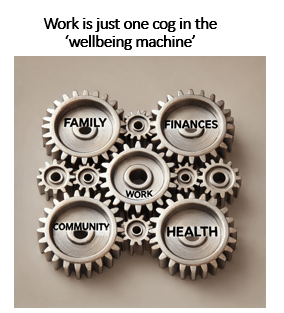
It’s important to recognise that workplace fulfilment is just one cog in a larger “wellbeing machine.” No matter how purposeful or supportive a school environment is, a teacher’s overall wellbeing also depends on factors beyond the school gates – family life, health, finances, and community connections, to name a few. Think of the broader wellbeing machine with multiple interlocking gears: one gear is work (career fulfilment), others include your relationships at home, your physical and mental health, your financial stability, and your sense of belonging in your community. In thinking about overall wellbeing, it may be helpful for school leaders and staff to consider each of the following constituent parts of the ‘wellbeing machine’;
Cog 1: Family & Friends?
I am able to lean on trusted others for support
Cog 2: Finances?
I am able to be financially independent
Cog 3. Health?
I am able to live a healthy and pain free life
Cog 4: Community & Connection (Charity / Church)?
I am able to make a difference to others in my community
Cog 5; Work?
I feel connected to the work I do and valued for my efforts
All these parts turn together to influence an individual’s overall wellbeing. If one gear grinds to a halt, it can affect the whole machine. For instance, a teacher might feel enormously purposeful at work, but if they are dealing with a serious health issue or financial stress, their overall wellbeing might still suffer – the machine squeaks and strains.
Modern research supports this holistic view. A comprehensive global study by Gallup identified five essential elements of wellbeing that echo our machine analogy: Career, Social, Financial, Physical, and Community wellbeing. To lead a thriving life, people benefit from strength in all five domains (Gallup, 2022). Career wellbeing (liking what you do each day and finding motivation in it) is one crucial element, but so is having supportive relationships, managing finances to reduce stress, maintaining health, and feeling connected to your community. Interestingly, Gallup found that career wellbeing can act as a cornerstone – what we do every day strongly shapes our identity and can boost our overall wellbeing. In fact, enjoying our work significantly influences our health and happiness outside of work (Rath & Harter, 2010). This means that as school leaders, by helping staff find fulfilment at work, we are actually contributing to their broader life wellbeing in a meaningful way. A positive, purpose-driven workday can spill over, helping someone be a more energetic parent, friend, or community member after hours.
However, we must remember that no single workplace can fulfil all aspects of a person’s life – nor should it be solely responsible for doing so. Work is one gear in the wellbeing machine; leaders should aim to keep that gear turning smoothly, while also respecting that staff have lives beyond school. Encouraging work-life balance, acknowledging family commitments, and being flexible when possible are ways schools can acknowledge those other “gears.” As one leadership piece put it, “both the individual, the group, the leadership, and the organization share the responsibility for well-being in the workplace.” (AS3, 2021).
In other words, everyone has a part in keeping the whole machine running.
Powering the Machine: Effort and Sacrifice
One of the less glamorous truths about wellbeing – that “wellbeing machine” – is that it runs on effort and, at times, sacrifice. This might sound counterintuitive; we often equate wellbeing with comfort or ease. But whether it’s maintaining good health, nurturing a family, or excelling at work, we achieve meaningful outcomes by putting in effort and often by giving up something in the short term. A teacher might sacrifice an hour of sleep to refine tomorrow’s lesson plan, or give up an afternoon during the week to take a booster group or coach a school team. These are sacrifices of personal time, yet they can also be sources of satisfaction when they’re aligned with a valued purpose. Leadership guru Tom Peters points out that only about 20% of people feel engaged at work – an “awful statistic,” which he largely attributes to poor leadership practices (Peters, cited in Schaefer, 2020). However, another way to read that statistic is that the vast majority of people are going through the motions (not truly invested) – likely because they don’t see the point of expending extra effort. If work feels meaningless, any sacrifice is just that: a sacrifice, with no redeeming payoff. The goal is to make effort feel worthwhile – to ensure the sacrifices teachers make lead to a sense of achievement and purpose, not just exhaustion.
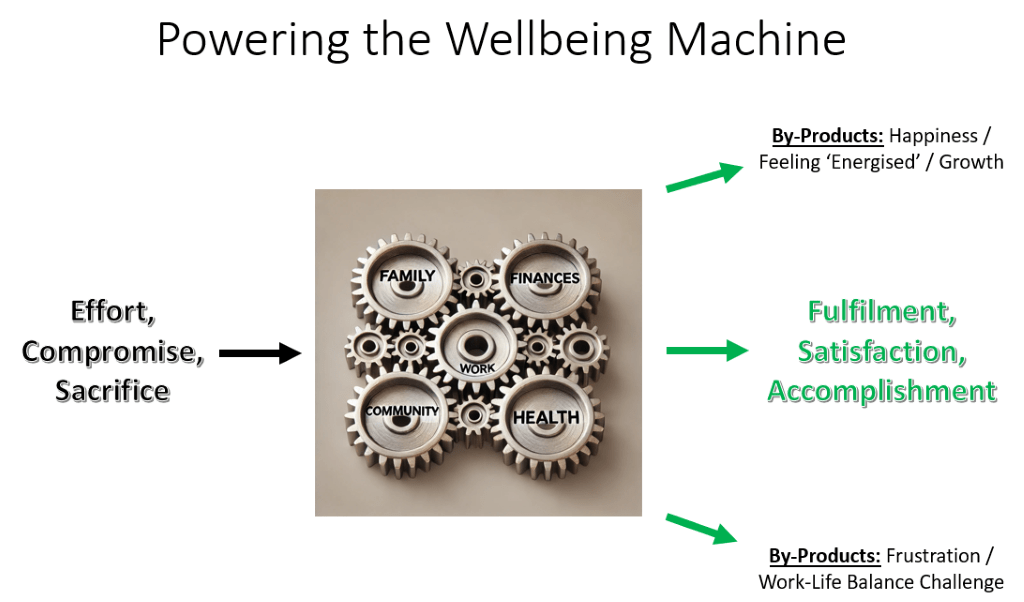
Psychologically, there’s a concept of “eustress” – the positive stress that pushes us to grow. When staff take on challenges that stretch their abilities in pursuit of a meaningful goal, they often experience this productive kind of stress. They’re working hard, maybe even tiring themselves out, but they feel invigorated rather than drained. A classic example is a teacher directing the school play: the effort put in can be exhausting, but when the final performance brings the house down, that teacher likely feels proud and fulfilled. As Simon Sinek put it, the difference comes down to caring about the why. Stress becomes passion when it’s for “something we love” (Sinek, 2009). Sinek and other leadership thinkers (like Patrick Lencioni, who speaks of “hungry” team players, or Angela Duckworth with “grit”) all circle back to this idea: people will go the extra mile, and even find joy in it, when it’s in service of a purpose they believe in.
Effort and sacrifice are also collective forces. In a supportive school culture, everyone from the principal to the newest teaching assistant contributes effort to keep the school’s wellbeing machine running. Sometimes that means leaders must sacrifice, too – perhaps giving up a bit of control to grant teachers more autonomy, or investing time and resources in staff development even when budgets are tight. Great leaders “provide care and protection for those for whom they are responsible” (to quote Sinek again) putting their people first (Sinek, 2009). Management author Tom Peters echoes this, famously saying successful businesses “treat…employees like people.” (Peters, cited in Schaefer, 2020).
That is, they recognise employees as human beings with needs and dreams, not just cogs in a machine – and therefore leadership must sometimes make hard choices to honour those needs. When staff see leaders also making an effort on their behalf – for example, a headteacher taking on a supervision duty to give a tired teacher a break – it creates a reciprocity. People naturally respond by investing more of themselves. Over time, this builds a culture where hard work is normal but it doesn’t feel exploitive or one-sided; it feels shared and meaningful.
Fulfilment and Satisfaction: Happiness as a By-Product
It’s worth clarifying what all this hard work and purpose is aiming for. In the end, what do we expect the “wellbeing machine” to produce? Our metaphorical machine is powered by effort and sacrifice, and its intended outputs are fulfilment and satisfaction. Notice we didn’t say its output is “happiness.” That’s because, in this model, happiness is more of an occasional by-product – a burst of joy when all the gears are turning smoothly – rather than a constant output. Modern psychology draws an important distinction between happiness and the deeper idea of life satisfaction or fulfilment. Nobel-winning psychologist Daniel Kahneman explains that “happiness and satisfaction are distinct”. Happiness is a fleeting feeling – the mood boost you get from a fun class activity or a compliment from a parent – while satisfaction is a longer-term state built over time. Satisfaction (or fulfilment) comes from achieving goals and “building the kind of life [or career] you admire” (Kahneman, 2011). It’s cumulative. One can have many happy moments at work yet still feel unsatisfied if those moments don’t add up to something meaningful. Conversely, one might have some tough days (not “happy” at all in the moment) but still feel deeply satisfied by the overall sense of purpose and progress.
In a school, happiness might show up as laughter in the staffroom on a Friday or the thrill of a successful lesson. These moments are wonderful – and a healthy school culture will hopefully produce plenty of them – but they can’t be the goal. Chasing constant happiness at work is like chasing a rainbow; you’ll end up disappointed because the feeling never lasts. Instead, by aiming for fulfilment and satisfaction, school leaders set a more realistic and ultimately rewarding target. Fulfilment means that at the end of the day (or term, or year), staff can look back and say: “That was tough at times, but it mattered, and I’m proud of what we accomplished.” They have a sense of pride and purpose that endures, even if not every day was fun.
Understanding happiness as a by-product also helps set more compassionate expectations. Neither leaders nor teachers should expect to be 100% happy and stress-free in their roles – that’s not the reality of meaningful work. There will be stressful meetings, late nights, even disagreements. But if the “wellbeing machine” is functioning, those challenges won’t derail a teacher’s overall sense of fulfilment. In fact, overcoming those challenges often enhances fulfilment. Psychologist Mihaly Csikszentmihalyi, who studied optimal experience or “flow,” found that people are often most satisfied after periods of intense effort that stretched their abilities – not during idle relaxation. The occasional happiness that emerges in a fulfilling workplace (a joyful team celebration after a big project, or a heartfelt thank-you note from a student) is all the sweeter because it’s earned, not expected as an entitlement (Csikszentmihalyi, 1990). As leaders, one of the best messages we can send to staff is this: We’re not here to guarantee you’ll be happy every minute. We’re here to support you in doing meaningful work, growing as professionals, and making a difference – and from that, we believe genuine satisfaction and yes, moments of happiness, will flow. This message treats educators as empowered adults who seek purpose over indulgence.
Leadership and Staff: Partners in Wellbeing
Adopting a fulfilment-centric, shared-responsibility model means rethinking the roles of both leadership and staff. It calls for a partnership approach. What does that look like in practice? Below are some key responsibilities on each side, which together create a positive feedback loop for wellbeing:
Leadership’s Role – Cultivating a Fulfilling Environment: School leaders set the tone and conditions for fulfilment. This involves:
- Inspiring a Shared Vision: Clearly communicate the school’s purpose and values, and show how each staff member’s work contributes to the big picture. As Kouzes & Posner remind us, leaders are at their best when they “Inspire a Shared Vision” and unite people around a common cause (2017, p. 105).
- Empowering and Trusting Staff: Give teachers autonomy in how they teach and run their classrooms (within clear curricular goals). Micromanagement saps motivation; trust fuels it. Encourage innovation and be tolerant of well-intentioned mistakes – this is how staff grow into mastery. Kouzes & Posner note that mutual respect and trust sustain extraordinary effort (2017).
- Providing Support and Resources: Ensure teachers have the tools and support they need to do their jobs well. This ranges from tangible resources (adequate supplies, prep time) to emotional support. Leaders should be approachable and listen actively to staff concerns. “Fostering a positive work environment” is a core leadership duty in promoting wellbeing
(The HR Director, 2021). - Recognition and Growth: Recognise and celebrate staff contributions authentically (a quick appreciative email, a shout-out in the staff newsletter, an award at year-end). People need to feel valued. Also, offer opportunities for professional development and career growth – show you’re invested in their progress. In The Leadership Challenge, this is called “Encourage the Heart,” acknowledging that genuine recognition “makes the recipient feel good, giving them a lift when they need it.” (Kouzes & Posner 2017, p. 105).
- Model Wellbeing and Boundaries: Leaders should model the balance they expect staff to maintain. That might mean the school leader actually takes a vacation and disconnects or goes home at a reasonable hour most days, signalling to staff that no one should be a martyr. It also means being vulnerable and human at times – acknowledging when you’re stressed and demonstrating healthy ways to cope (so teachers feel permission to do the same). As Brené Brown writes, “a leader is anyone who takes responsibility for finding the potential in people and… has the courage to develop that potential.” (Brown, 2018).
Staff’s Role – Engaging and Communicating: Teachers and staff are not passive recipients of wellbeing; they are active agents. Key responsibilities include:
- Aligning with the Vision and Values: This doesn’t mean blind agreement with every decision, but it does mean genuinely attempting to understand the school’s goals and finding personal meaning in them. When hiring, it helps to bring on people who resonate with the school’s ethos – as Sinek says, “if you hire people who believe what you believe, they’ll work for you with blood, sweat, and tears.” (Sinek, 2023)
- Applying Meaningful Effort: Fulfilment requires doing; it’s an active process. This means bringing energy and professionalism to the role – being willing to put in effort even when it’s challenging, as long as it’s towards meaningful ends. It’s the teacher choosing to spend extra time tailoring feedback on essays because it helps students grow, rather than half-heartedly doing the bare minimum. It’s also about embracing the mindset of continuous improvement (the growth mindset). By investing effort in their own development – trying new teaching strategies, reflecting on their practice – staff create their own sense of progress and accomplishment.
- Communication and Boundaries: Just as leaders must listen, staff must speak up. A shared-responsibility model works only with honesty and communication. If you’re struggling with something – whether it’s an unmanageable class, a personal issue affecting work, or an idea for improvement – communicate with your leadership.
- Contributing to a Positive Community: School culture is shaped by every member. Teachers and support staff can support colleagues, share ideas and contribute to an atmosphere of collegiality (for instance, mentoring a new teacher or simply refraining from gossip and negativity). Research on belonging at work shows that when people feel connected and proud of their organisation’s values, they are more engaged and loyal. Staff can foster that sense of community by including others and honouring the school’s values in daily interactions. Something as simple as expressing appreciation to a colleague or collaborating on a problem exemplifies shared ownership of wellbeing (YouGetToWork, 2022).
When both leadership and staff fulfil these responsibilities, they create a virtuous cycle. Leaders build trust by supporting and empowering staff; staff respond by engaging and giving their best; this in turn validates the leadership efforts and encourages them to continue investing in staff wellbeing. Over time, this partnership yields a school culture where fulfilment is prevalent – where people routinely “go to bed fulfilled by the work they do,” to quote Sinek’s vision of an ideal workplace (Sinek, 2023). In such a culture, challenges will still arise – budget cuts, policy changes, even pandemics – but the foundation of shared trust and purpose makes the community more resilient.
Towards Sustainable Staff Wellbeing
Reframing staff wellbeing around fulfilment and shared responsibility is ultimately about sustainability. The old paradigm of wellness in schools sometimes leaned toward quick fixes or placing the burden solely on one side: “If only teachers were more resilient,” or “If only leadership gave us Fridays off.” Those approaches rarely moved the needle in the long run. In contrast, a fulfilment-focused model asks deeper questions: Do our staff find meaning here? Do they feel supported and able to grow? Do we each know our part in this social contract? By asking and addressing these, school leaders can cultivate an environment that naturally supports wellbeing day in and day out – not through constant cheerfulness or the absence of stress, but through a bedrock of purpose, respect, and mutual care.
As a school leader, you can start this journey by initiating open conversations about fulfilment with your team. Discuss the school’s “why” and listen to personal “whys” of your staff. Acknowledge the realities outside of work – the family and community commitments – and look for reasonable ways the school can accommodate or support those (for example, flexible scheduling for a teacher pursuing a part-time graduate course, or hosting family-inclusive school events). Simultaneously, encourage your staff to identify what they need for their own wellbeing and to take proactive steps (perhaps a teacher pairs up with a “wellbeing buddy” on staff to check in weekly about workload and stress management). These kinds of initiatives send a clear message: We’re in this together.
When the “workplace fulfilment” of school life is well established the outcome is a school where people want to work. You’ll likely see it in higher staff retention, stronger performance and a positive atmosphere that visitors can almost feel in the hallways. Teachers in such an environment often say things like, “We work hard here, but it’s worth it,” or “I feel like I’m part of something meaningful.” That sense of fulfilment is both the proof and product of a healthy, shared-responsibility approach to wellbeing. And yes, when things are running well, you’ll notice more smiling faces (those by-product moments of happiness).
In closing, shifting from a staff-vs-leadership blame game to a staff-plus-leadership partnership centered on fulfilment could be one of the most impactful leadership moves a school leader can make. It aligns with what research and renowned thinkers have been telling us: purpose and people matter most. By focusing on those, you create the conditions for your staff to not only be well, but to do well – for themselves, for the students, and for the whole school community. After all, a school where teachers and leaders work with each other to find meaning and support is a school where everyone – adults and children alike – can thrive. Fulfilment is contagious; a fulfilled teacher is more likely to inspire students and contribute to a virtuous cycle of positivity and achievement.
So, let’s model that from the top. Encourage effort with empathy, expect excellence with support, and treat wellbeing not as a box to tick but as an ongoing, shared journey. In doing so, we honour the truth that “we are the engineers of each other’s experience” (YouGetToWork, 2022). By working together, we can engineer an experience of work that is enriching, purpose-driven and yes, sometimes even happy. And that is a legacy of leadership worth striving for.
Sources:
- AS3 (2021). Who is Responsible for Wellbeing? [online] Available at: https://www.as3transition.co
- Brown, B. (2018). Dare to Lead. (Principles of trust, vulnerability, and belonging in leadership yougettowork.com
- Collins, J. & Porras, J. (1994). Built to Last: Successful Habits of Visionary Companies. (Quote on alignment globaladvisors.biz
- Csikszentmihalyi, M. (1990). Flow: The Psychology of Optimal Experience. New York: Harper and Row.
- Gallup (2022). State of the Global Workplace 2022 Report. [online] Available at: https://www.gallup.com
- Gallup (2010). Wellbeing: The Five Essential Elements. (Five domains of wellbeing
gallup.com
- Kahneman, D. (2010). Discussion on happiness vs. Satisfaction ritholtz.com
. Princeton University/Robert Wood Johnson Foundation.
- Kouzes, J. & Posner, B. (2010). The Leadership Challenge. (Common purpose, trust & collaboration quote
azquotes.com
- Pink, D. (2009). Drive: The Surprising Truth About What Motivates Us. (Intrinsic motivation: autonomy, mastery, purpose bitesizelearning.co.uk
- Sinek, S. (2009). Start With Why: How Great Leaders Inspire Everyone to Take Action. (Various insights on purpose and passion
fleurdelyz.com
- Sinek, S. et al. (2023). “5 Signs Your Employer Wants You to Find Meaning in Your Work.” The Optimism Company (Statistics on purpose at work simonsinek.com
, vision of fulfilled by work simonsinek.com
- Hogan Assessments (2022). “Employee Well-Being: Whose Responsibility Is It, Anyway?” (Shared responsibility and communication
hoganassessments.com
- Peters, T. (2021/2023). Interviews and quotes (Engagement statistics
businessesgrow.com; “treat employees like people” azquotes.com
- YouGetToWork (2022). Why Belonging Matters at Work. [online] Available at: https://www.yougettowork.com
 The Infinite Headteacher